Published on October 14, 2025, by Felix Martinez
High-yield stocks are an attractive investment option, offering dividends that significantly exceed the market average. For instance, the S&P 500 currently yields around 1.1%, a reflection of the record highs in stock indices throughout 2025.
These high-yield stocks can be particularly beneficial for retirees looking to supplement their income. A $120,000 investment in stocks with an average dividend yield of 5% can generate approximately $500 a month in dividends.
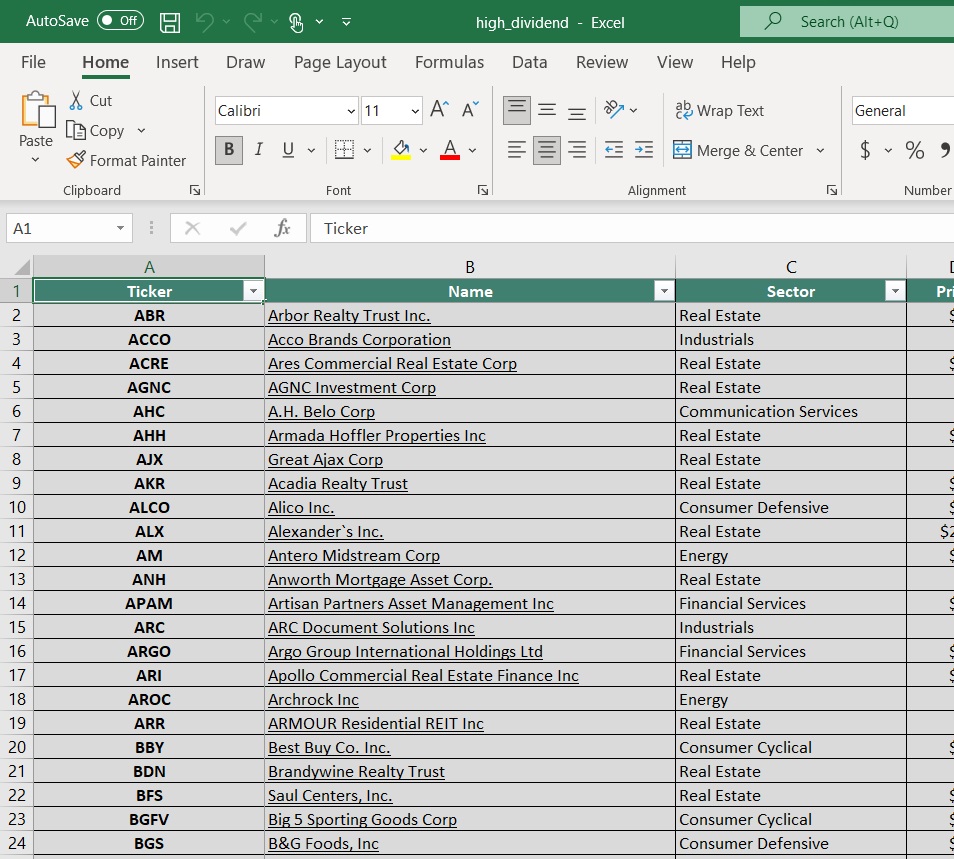
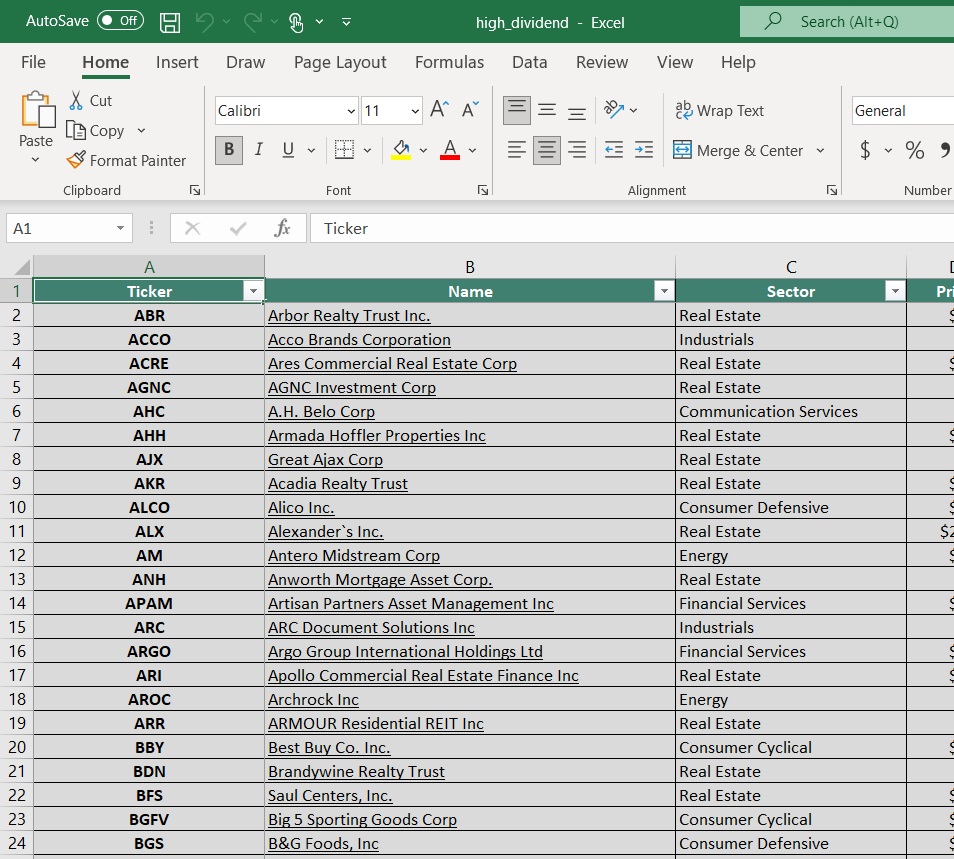
To assist investors, we have compiled a comprehensive spreadsheet of stocks, including closely related REITs and MLPs, that boast dividend yields of 5% or more. You can download your free full list of all high dividend stocks with 5%+ yields, complete with essential financial metrics such as dividend yield and payout ratio, by clicking the link below:
Next on our list of high dividend stocks to review is Horizon Bancorp, Inc. (HBNC).
Business Overview
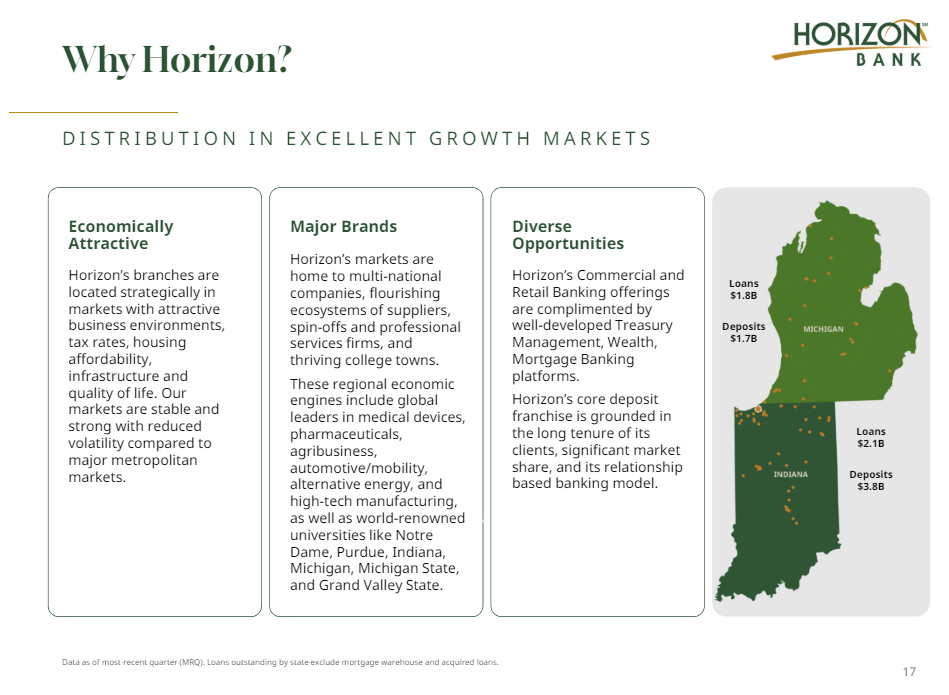
Horizon is a bank holding company for Horizon Bank, providing a wide array of commercial and retail banking services and products. Their offerings include checking and savings accounts, money market accounts, certificates of deposit, retirement accounts, and various types of consumer and commercial loans, as well as insurance products.
Founded in 1873, Horizon operates in Indiana and Michigan.
Source: Investor presentation
On July 23, 2025, the bank reported its second-quarter earnings, showcasing significant improvements compared to the previous quarter.

Source: Investor presentation
The company reported robust second-quarter results for 2025, with net income reaching $20.6 million, or $0.47 per diluted share, marking a 26% increase year-over-year and exceeding estimates by $0.03. Revenue surged 26% to $70.3 million, driven by higher-yielding loans and effective deposit cost management. The net interest margin expanded to 3.23%, reflecting the seventh consecutive quarterly increase, while loan growth rose 6.2% annualized, primarily in commercial lending. Credit quality remained strong, with minimal charge-offs at 0.02%, and the efficiency ratio stabilized at 59.5%. Deposits saw a slight decline of 1.1% as the bank managed higher-cost time deposits.
As of June 30, 2025, Horizon’s total assets were $7.7 billion, with tangible book value per share increasing to $14.32. Capital levels remained robust, with a Tier 1 ratio of 12.52% and a total capital ratio of 14.48%. CEO Thomas Prame emphasized the bank’s operational strength and margin expansion, noting a 58% year-over-year increase in EPS for the first half of 2025. Looking forward, Horizon anticipates sustained earnings growth supported by prudent expense control, steady loan demand, and improved funding costs, positioning the bank for consistent shareholder returns throughout the remainder of 2025.
Growth Prospects
Horizon’s earnings growth has been inconsistent. While the bank has managed to increase its earnings over time, it has experienced three years of declining earnings in the past decade, including last year.
We project an 8% growth from this year’s base of $1.42.
Source: Investor presentation
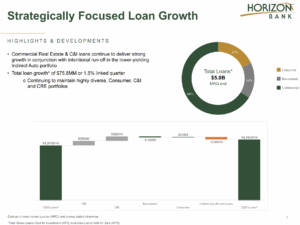
To achieve this growth, Horizon is likely to focus on expanding its loan portfolio, which has been a key area of concentration in recent quarters. In Q2, the bank increased its loan portfolio by $76 million, primarily driven by growth in commercial real estate and commercial and industrial (C&I) loans.
Competitive Advantages & Recession Performance
Like many banks, Horizon lacks distinct competitive advantages. Most banks offer similar products and services, so smaller institutions like Horizon often depend on brand loyalty and the convenience of office locations for customer retention. However, these advantages are tenuous at best, akin to those of other banks.
Moreover, Horizon is vulnerable to recessionary periods, and we expect its earnings to be affected during the next economic downturn. Nevertheless, the bank demonstrated relative resilience during the last major economic crisis, the Great Recession of 2008-2009:
- 2008 earnings-per-share: $0.54
- 2009 earnings-per-share: $0.47
- 2010 earnings-per-share: $0.54
Horizon’s strong credit quality will be an asset during the next recession, but it is important to note that no bank can control loan demand during economic downturns or borrowers’ ability to repay.
Given Horizon’s struggles to grow earnings in recent years, even amidst strong economic growth, we approach the bank with caution as we look ahead to the next recession.
Dividend Analysis
Horizon has successfully increased its dividend by an average of nearly 11% annually over the past decade, which is impressive for the banking sector. However, it has not raised its dividend in the last two years, and we do not anticipate an increase this year either. Despite a low payout ratio of 34%,
the current annual dividend of 64 cents per share is less than half of earnings, suggesting it is secure for the foreseeable future. While we believe Horizon’s capacity to raise the dividend is somewhat limited, modest increases are likely in the coming years.
The yield is robust at over 4%, driven by strong dividend growth and a relatively stagnant share price. Overall, we appreciate the yield and the relative safety of the payout, but we foresee limited potential for substantial increases.
We encourage investors to monitor the net interest margin, as it currently represents a weak point for Horizon in terms of earnings, directly impacting its ability to raise dividends.
If you are interested in discovering high-quality dividend growth stocks or other high-yield securities, the following Sure Dividend resources will be beneficial:
High-Yield Individual Security Research
Other Sure Dividend Resources
Thanks for reading this article. Please send any feedback, corrections, or questions to support@suredividend.com.