

Last week, FTSE conducted its annual review of country classifications within its global equity indices (see the announcement here). One of the most notable changes was Vietnam’s upgrade from frontier to emerging market status. This transition will impact all FTSE indexes starting September 2026, likely with a phased implementation. This upgrade comes after years of Vietnam being on the watch list as its market matured.
The benefits of this upgrade are significant:
- Existing Vietnam ETFs are likely to see price benefits and increased net inflows.
- Emerging market indexes (and corresponding ETFs) may include Vietnam starting in 2026.
- In the long term, Vietnam’s economy could benefit from heightened sentiment and exposure, particularly regarding IPOs in the equity market.

First of All — What Is a Frontier Market?
The term “frontier” market is less familiar than developed and emerging markets, and for good reason. FTSE classifies countries as developed, advanced emerging, secondary emerging, and frontier (from most to least developed). Currently, around 30 countries are classified as frontier markets, including Bulgaria, Croatia, Kenya, Morocco, and Pakistan. Frontier status indicates markets that meet minimum investability and accessibility standards but do not meet secondary emerging thresholds. Notably, FTSE allows end-of-day (rather than real-time) prices for a market to qualify at the frontier level, suggesting significantly less liquidity and pricing transparency.
For full details on FTSE’s classification system, see their paper here.
No ETF Opportunities in the Frontier Segment
It’s not surprising that U.S.-listed frontier ETFs have ceased to exist due to liquidity issues. Countries with greater liquidity have often been upgraded to emerging market status, leaving behind those that are illiquid. Recently, two frontier market ETFs closed, likely due to these liquidity challenges. Invesco announced the termination of its Frontier Markets ETF (FRN) in late 2019, with the last trading day in February 2020. Similarly, BlackRock announced the liquidation of the iShares Frontier and Select EM ETF (FM) in 2024, with the last trading day in January 2025.
Change to Emerging Market ETFs
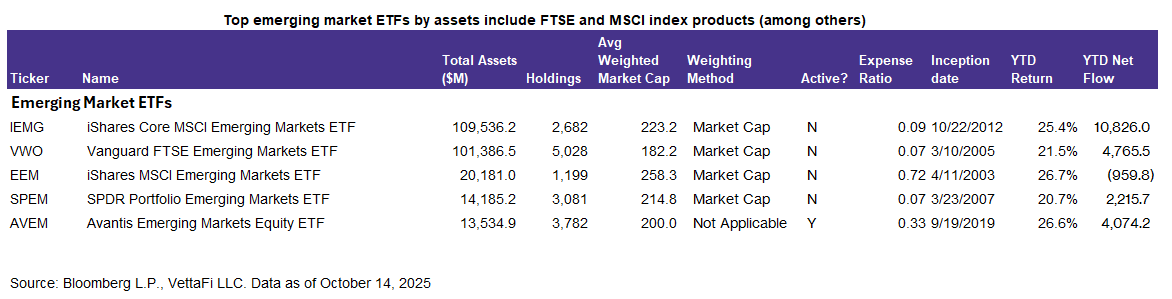
As mentioned, changes to the FTSE index will begin rolling out in September 2026, with a review period in March 2026. This means that Vietnam exposures could be added to certain ETFs, particularly those tracking FTSE emerging market indexes. The Vanguard FTSE Emerging Markets ETF (VWO) is the second-largest emerging market ETF, with assets around $102 billion. However, a small allocation to Vietnam in the low single digits is expected. Currently, VWO is heavily weighted toward larger markets like China, Taiwan, and India, allocating 4% or less to other countries. Another ETF that could be affected is the Schwab Emerging Markets Equity ETF (SCHE), which also tracks a FTSE emerging markets index.
It’s important to note that MSCI has its own classification system and review process, which remains unaffected by FTSE’s changes. Several large emerging market ETFs follow MSCI indexes, including the iShares Core MSCI Emerging Markets ETF (IEMG) and the iShares MSCI Emerging Markets ETF (EEM).
Vietnam ETFs May Be Used to Express Bullish Views Beyond a Broad Emerging Market Allocation
Following Vietnam’s upgrade, ETF prices have already seen a boost, with VNM up around 8% and VNAM up around 7% since the announcement. The long-term effects are expected to be more pronounced as Vietnam’s equity markets mature, potentially stimulating IPO activity. Additionally, Vietnam has existing tailwinds; for instance, Apple recently announced plans to shift its home device manufacturing hub to Vietnam, reducing its dependence on China. This trend is likely to continue as manufacturers diversify operations into nearby countries that offer relatively inexpensive labor. Year-to-date, Vietnam ETFs have risen approximately 70%.
Currently, there are two Vietnam ETFs:
- The VanEck Vietnam ETF (VNM), launched in August 2009, is the oldest and largest Vietnam ETF, with $609 million in assets. Nearly two-thirds of its weight is in real estate and financials, with its top ten holdings comprising around 60% of the ETF’s weight.
- The Global X MSCI Vietnam ETF (VNAM) was launched in December 2021 and has around $25 million in assets. Although smaller, VNAM has a slightly lower fee (51 basis points versus 68 basis points). Its composition is similar to VNM, with a majority in real estate and financials, but it allocates more to its top holding, Vingroup (VIC VN), at 17% compared to 12% for VNM.

Where to Use Vietnam ETFs in a Portfolio?
Even if Vietnam is added to emerging market ETFs, that allocation will likely be minimal in market-cap weighted ETFs. Single-country ETFs like VNM or VNAM can provide supplemental exposure. They can serve as satellite positions alongside a more diversified international portfolio or be used as shorter-term tactical positions to express a bullish view. Additionally, their sector makeup complements larger economies like the U.S. and China, given Vietnam’s limited exposure to technology and consumer discretionary sectors.

For more news, information, and strategy, visit ETF Trends.