
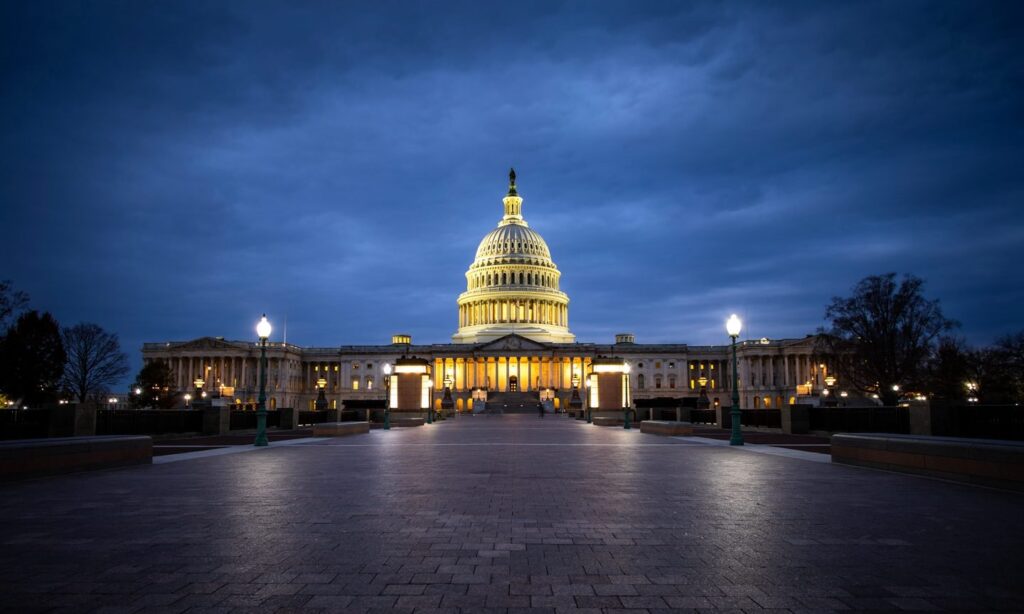
The U.S. government has officially shut down after Congress failed to pass funding legislation before the midnight deadline on Tuesday.
On Tuesday, the Senate voted on two separate bills aimed at keeping the government funded. One bill had already passed in the House and was backed by Republicans, while the other was an alternative resolution proposed by Democrats. Unfortunately, both bills failed to secure the necessary 60 votes for passage.
So, what happens now? For starters, nonessential services have ceased operations, leading to many thousands of federal workers being furloughed. Essential staff, however, are still required to report to work, albeit without pay. This shutdown also means delays in various benefit programs, financial aid, IRS verifications, and potential travel disruptions.
What happens when the government shuts down?
Federal workers will feel the most significant impact of the shutdown. Additionally, the Office of Management and Budget recently issued a memo advising agencies to consider mass layoffs during a shutdown. While furloughs are standard, the legality of permanent layoffs due to a funding lapse remains uncertain.
The shutdown will also create ripple effects on the delivery of government services and programs.
What’s affected immediately:
-
National parks may close or operate without services.
-
Processing of federal student aid applications could be delayed, coinciding with the opening of the Free Application for Federal Student Aid (FAFSA).
-
Food and drug inspections will face delays.
-
The IRS will be unable to verify income and Social Security numbers, potentially delaying mortgages, loan approvals, and tax refunds.
What will keep running, to a point:
-
Flights will continue to operate, but delays may occur if TSA agents and air traffic controllers, deemed essential employees, call out of work, leading to staffing shortages. Even minor shortages can have significant impacts; during a previous shutdown, the absence of just 10 air traffic controllers at two airports caused widespread flight delays.
-
Social Security and Medicare will continue, although some administrative functions may be suspended, and telehealth appointments could be interrupted.
-
Unemployment benefits will persist, as states administer compensation, but application processing delays may occur if the shutdown extends.
-
Food benefits through the Supplemental Nutrition Assistance Program (SNAP) and the Women, Infants, and Children (WIC) program will continue, as both operate on contingency funds. However, WIC funding will last only one month, and SNAP may face strains after 30 days.
What won’t be affected:
-
The postal service remains unaffected, as the USPS is not funded by the federal government.
-
Federal student loan payments will continue, as accounts are serviced by private companies.
-
Public schools will remain open, funded by state and local governments.
-
Amtrak will continue its operations, as it is run by a for-profit company.
The shutdown could have trickle-down economic effects, depending on its duration. One immediate impact will be the suspension of federal economic data releases, including the monthly jobs report scheduled for Friday. The Bureau of Labor Statistics will also halt data collection, which is problematic as government data releases guide markets, the Federal Reserve, and business decisions.
How did the government shutdown occur?
Each year, Congress is tasked with passing 12 spending bills to keep the government operational. These appropriations bills fund various programs, including defense, the IRS, food assistance, veterans’ benefits, and national parks.
»
Stay informed:
Check out our
news hub
for all the latest.
The deadline for funding programs for the upcoming fiscal year—2025-2026—is always October 1. If Congress fails to pass appropriations bills or approve a stopgap measure, the government will shut down.
Why didn’t Congress pass the funding bills? The two parties are at an impasse over Democrats’ demands to permanently extend expiring Obamacare subsidies and roll back recent Medicaid cuts in the “
one, big beautiful bill
.”
On Tuesday, the Senate rejected two funding bills: one from Democrats that included the aforementioned stipulations and another “clean” stopgap already approved by House Republicans. In recent funding cycles, Congress has often relied on multiple short-term continuing resolutions to keep the government running temporarily.
On Monday, congressional leaders from both parties met with President Donald Trump to negotiate but failed to reach any agreement.
How long will the government shutdown last?
The duration of this shutdown remains uncertain. Since 1976, there have been 21 shutdowns, most of which were short-lived—lasting only a few hours or days.
The last significant shutdown occurred from 2018 to 2019, lasting 35 days—the longest in history—due to a dispute over funding for Trump’s border wall. Prior to that, a 16-day shutdown in 2013 resulted from negotiations over the Affordable Care Act, while two shutdowns in 1995 and 1996 totaled 26 days.
For more
on the effects of a government shutdown, listen to our Smart Money podcast episode from last week.