

What’s the Difference Between SPX and SPY Options?
What Is SPX?
SPX refers to the S&P 500 index, a key stock market index that tracks the performance of 500 large-cap publicly traded companies in the United States. It is widely recognized as one of the most reliable indicators of the overall performance of the U.S. stock market.
The SPX value is derived from a weighted average of the stock prices of these 500 companies, with weights based on each company’s market capitalization. As a benchmark, SPX is frequently used to gauge the performance of large-cap U.S. stocks.
The S&P 500 index is managed by S&P Dow Jones Indices and is one of the most closely monitored stock market indices globally, serving as a benchmark for investors, analysts, and financial professionals.
What Is SPY?
The SPDR S&P 500 ETF Trust (SPY), commonly known as SPY, is an exchange-traded fund designed to track the performance of the S&P 500 index. Launched in 1993, SPY is among the oldest and largest ETFs, boasting over $375 billion in assets under management as of May 1, 2023. It trades on the NYSE Arca exchange, allowing investors to buy and sell it like a stock through a brokerage account.
Investing in SPY offers exposure to a diversified portfolio of large-cap U.S. stocks, making it a popular choice for those looking to invest in the U.S. stock market. As it mirrors the S&P 500 index, SPY is often used as a benchmark for the overall market performance.
Dividends
Dividends are typically not paid to options holders. However, SPY pays a quarterly dividend, which is crucial for traders holding in-the-money (ITM) call options. To collect the dividend, options must be exercised before the ex-dividend date, or the trader must own shares and place a call (known as a covered call option).
It’s essential to monitor ITM calls closely, as many are exercised for the dividend on expiration Friday. If you hold these options, you cannot afford to miss out on the dividend.
The ex-dividend day for SPY occurs on the third Friday of March, June, September, and December. If this day falls on a non-business day, it is moved to the next business day.
Trading Style
There are two primary trading styles: European and American. European options can only be exercised on the expiration date, while American options can be exercised at any time before expiration.
SPY options are American-style, allowing for exercise at any point after purchase (before expiration).
Expiration
SPX options that expire on the third Friday stop trading the day before, on the third Thursday. On expiration Friday, the settlement price is determined by the opening prices of each stock in the index, which serves as the closing price for that cycle. Conversely, SPY options cease trading at the close of business on expiration Friday.
Note
All SPX options expire at the close of business on expiration Friday, except those expiring on the third Friday of the month.
Settlement
SPY options are settled in shares, meaning that exercising your options results in buying (or selling) shares of the ETF. In contrast, SPX options are settled in cash; if you exercise and are in the money, cash is deposited into your brokerage account.
Value
An SPX option is approximately 10 times the value of an SPY option. For instance, on April 9, 2020, SPX closed at 2,789.82 points, while SPY closed at $278.20.
It’s crucial to understand that one SPX option with the same strike price and expiration is roughly 10 times the value of one SPY option. Thus, each SPX point equates to $100.5.
For example, if SPX is at 2,660 points, an in-the-money SPX option grants the right to buy $266,000 worth of the underlying asset ($100 x 2,660).
Conversely, one SPY option allows the owner to buy $26,600 worth of ETF shares (10% of $266,000).
Liquidity
SPY features very “tight” bid/ask spreads, which aids in planning and provides a clearer execution price. This allows for the use of market orders, which are easier and can execute much faster than limit orders. Many brokers, including Fidelity, offer price improvements with market orders, resulting in favorable execution prices.
In contrast, SPX has a relatively wide bid/ask spread compared to SPY, necessitating the use of limit orders. This approach involves some “bargaining” with the price and can lead to slower execution. It is more time-consuming and less precise, leaving traders uncertain if they received the best price.
Some traders prefer ETFs like SPY for better liquidity, but they often overlook that index options are significantly larger products. For instance, a 20-cent spread on RUT is equivalent to a 2-cent spread on IWM. A spread of 10.00/10.50 on RUT would translate to 1.00/1.05 on IWM, with slippage on RUT typically not exceeding 10-15 cents, which is about 1-1.5 cents on IWM.
Commissions
The number of contracts purchased can significantly impact commissions. For example, buying one lot of a 10-strike SPX Iron Condor involves trading 8 round-trip contracts, costing $8 or 0.8% of a $1,000 margin. In contrast, purchasing 10 lots of a 1-strike SPY Iron Condor results in commissions of $80, or 8% of the $1,000 margin.
Tax Treatment Differences
A significant advantage of index options lies in their unique tax treatment. The IRS categorizes these indexes differently from stocks or ETFs.
Index options benefit from special Section 1256 treatment, allowing investors to have 60% of gains taxed as long-term (at a 15% rate) and 40% as short-term (at the regular 35% short-term capital gains rate), even if held for less than a year.
In contrast, ETFs are treated like ordinary stocks, meaning that if held for less than a year, all gains are taxed at the less favorable 35% short-term capital gains rate.
Consequently, index options can offer better tax advantages. It’s advisable to consult with a tax advisor to understand how these implications may affect your situation. In summary, SPX tax treatment is significantly more favorable than SPY’s. While SPY has advantages in LEAPS, it cannot compete with the benefits offered by SPX. Remember, it’s not just about what you make; it’s about what you keep.
Which Is Right For You?
The assets within SPX do not trade, meaning there are no shares available for buying or selling. Instead, options are structured to allow traders to speculate on the S&P 500’s price movements. SPX operates as a theoretical index, with a price calculated as if it were a true index.
Note
The 500 specific stocks in the index are rebalanced quarterly in March, June, September, and December. Traders should be mindful of these times, as they may present new opportunities to enter and exit positions.
This means SPX has an exact number of shares of each of the 500 stocks. While the SPX itself may not trade, both futures contracts and options based on the index do, which is why SPX options are settled in cash.
On the other hand, SPY options are settled in shares since shares are actively traded on an exchange. Therefore, the options contracts are structured to allow you to take possession of shares when you exercise your option.
The choice between SPX and SPY options depends on your strategy and goals. If you prefer to take possession of shares for holding or further trading, SPY may be the better option. Conversely, if you prefer trading for value and receiving cash in your account, SPX is an excellent choice.
However, trading SPY options does come with additional risks. For example, if you end up owning shares on the Monday following expiration, you’ll owe the price of those shares at the expiry time, not the price on Monday. If the share price drops on Monday, you may pay more than their current worth. Conversely, if the price rises, you may pay less than the market price.
The Bottom Line
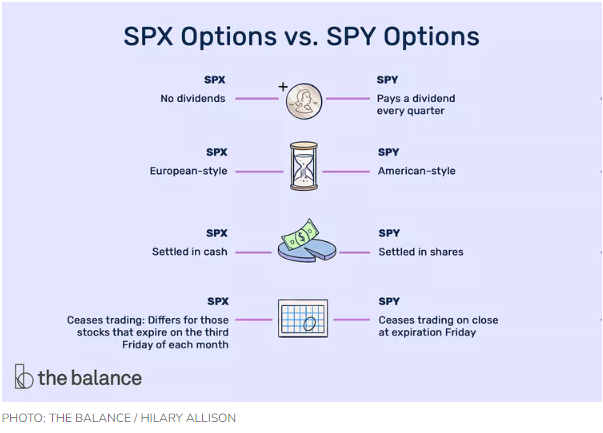
The primary differences between SPY and SPX options lie in their trading styles—American vs. European—and the fact that SPY options are based on an ETF, while SPX options are tied to the index’s price itself. Understanding these differences is crucial for exercising your options effectively. Additionally, the variations in value and settlement impact the capital required to purchase the options.
SPX clearly excels in “assignment risk,” “trading costs,” and “taxable account” scenarios. However, it falls short in terms of flexibility and convenience. For traders operating in IRAs and ROTHs, SPX should be given serious consideration. Sometimes, it’s better to invest a little more to avoid potential pitfalls.
For those with taxable accounts, the tax advantages of SPX far outweigh any increase in costs. Ultimately, it comes down to your willingness to invest extra time and effort for tax savings.
If you have more capital available and do not require dividends, SPX might be the ideal choice. Conversely, if you’re short on funds and can benefit from dividends, SPY may be more suitable.
Mark Wolfinger has been in the options business since 1977, when he began his career as a floor trader at the Chicago Board Options Exchange (CBOE). Since leaving the Exchange, Mark has been giving trading seminars as well as providing individual mentoring via telephone, email, and his premium Options For Rookies blog. Mark has published four options trading books. His Options For Rookies book is a classic primer and a must-read for every options trader. Mark holds a BS from Brooklyn College and a PhD in chemistry from Northwestern University.
Related articles