

juststock/iStock via Getty Images
Small Caps Are (Finally!) on Top.
In the third quarter of 2025, a combination of high returns, lower interest rates, and a resilient U.S. economy propelled major U.S. indexes to new heights. Notably, small-cap stocks outperformed their larger counterparts, with the Russell 2000 Index rising by 12.4%, compared to an 8.0% gain for the Russell 1000 Index. This marked a significant and long-awaited advantage for small-cap stocks.
Micro-caps demonstrated even stronger performance, as the Russell Microcap Index surged by 17.0%.
Interestingly, while small-cap returns were broad-based, large-cap returns were more concentrated, heavily leaning towards technology stocks, particularly those with AI exposure. The Nasdaq Composite increased by 11.4%, while the mega-cap Russell Top 50 Index climbed 10.7% in 3Q25.
A Banner Quarter for U.S. Stocks
3Q25 Russell Index Returns

Past performance is no guarantee of future results.
Double-Digit Gains Off the April Lows
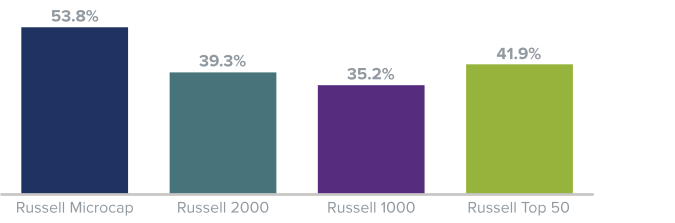
After a bearish start to 2025, which included sharp sell-offs following “Liberation Day” on April 2nd, equities rebounded dramatically. From April 8th to September 30th, the Russell 2000 gained an impressive 39.9%, outperforming the Russell 1000’s 35.2% advance.
As seen in 3Q25, the highest returns were concentrated in the smallest and largest stocks, particularly those with tech exposure. The Russell Microcap rose 53.8% during this period, while the Russell Top 50 increased by 41.9%, and the Nasdaq surged by 48.9%.
Impressive Strength for U.S. Stocks
Russell Index Returns, 4/8/25-9/30/25
Past performance is no guarantee of future results.
For the year-to-date period ending September 30, 2025, large-caps maintained their performance advantage, with the Russell 2000 rising 10.4% compared to 14.6% for the Russell 1000. However, micro-caps outperformed large-caps, increasing by 15.7%, while the mega-cap Russell Top 50 gained 16.5%.
Foreign Affairs
Non-U.S. stocks experienced a cooler quarter, yet they have shown steady positive performance in 2025, avoiding the bearish sentiment that affected most U.S. indexes in the first quarter. The MSCI ACWI ex-USA Small Cap Index rose 6.7% in 3Q25, while the MSCI ACWI ex-USA Large Cap Index increased by 7.2%.
Both indexes were nearly tied for the year-to-date period through September, with the MSCI ACWI ex-USA Small Cap up 25.5% and the MSCI ACWI ex-USA Large Cap also up 25.5%. Annualized returns were similarly close for the 1-, 3-, 5-, and 10-year periods ending September 30, 2025, although small-caps had a slight edge in the 10-year period.
The Small-Cap Style Story
Despite the strength of mega-cap tech stocks and lower-quality small-caps in 3Q25, the spread between small-cap style indexes was surprising. Typically, small-cap growth leads in early phases of an upswing. However, the Russell 2000 Value Index gained 12.6% in 3Q25, slightly outperforming the 12.2% return of the Russell 2000 Growth.
From April 8th to September 30th, small-cap growth took the lead, with the Russell 2000 Growth rising 43.2% compared to 35.3% for the Russell 2000 Value. For the year-to-date period ending September 30, 2025, small-cap growth also led, increasing by 11.7% versus 9.0% for the small-cap value index. Over longer spans, the Russell 2000 Growth outperformed the Russell 2000 Value for the 1-, 3-, and 10-year periods, while the Russell 2000 Value excelled in the 5-year period ending September 30, 2025.
The Small-Cap Sector Story
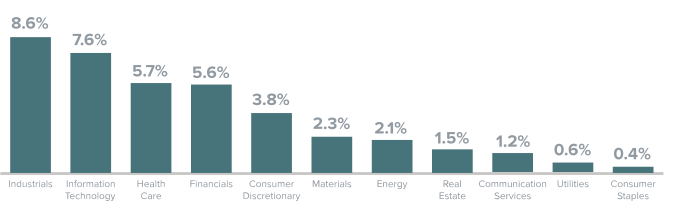
In another indicator of broad-based gains for small-cap stocks, all 11 sectors within the Russell 2000 contributed positively in 3Q25. Notably, Industrials, Information Technology, Health Care, and Consumer Discretionary performed exceptionally well, with cyclical sectors outperforming defensive ones, as expected in a growing economy. Every sector except Energy and Real Estate finished the year-to-date period in positive territory, with Industrials and Tech leading by substantial margins.
All 11 Sectors Contributed to 3Q25 Performance
3Q25 Sector Contributions in the Russell 2000
Past performance is no guarantee of future results.
A similar trend was observed in small-cap sector performance from the early April lows. From April 8th to September 30th, the top contributors were Industrials, Information Technology, and Financials, with all 11 sectors remaining in positive territory.
The Case for Sustained Small-Cap Leadership
Concerns regarding high valuations for U.S. equities have been prevalent in recent years, primarily focusing on larger stocks. However, small-cap stocks appear to be more reasonably valued compared to their larger counterparts, which have garnered most of the attention regarding valuations.
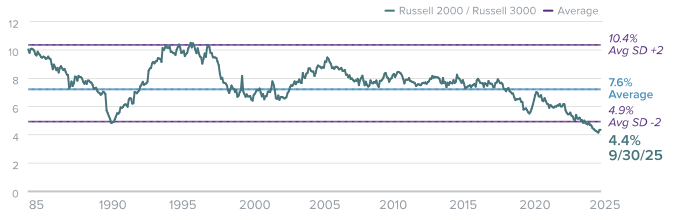
Two examples illustrate our belief that small-cap stocks are still attractively valued. First, the Russell 2000’s weight as a percentage of the Russell 3000 Index has historically averaged 7.6% since late 1984. Despite the recent uptick from the April lows, the Russell 2000’s weight was only 4.4% at the end of September, significantly below the long-term average.
Small-Cap’s Weight in the Russell 3000 is Below Historical Low
Russell 2000 Total Market Cap as a Percentage of Russell 3000 Total Market Cap (%), 9/30/84 through 9/30/25
Source: FactSet.
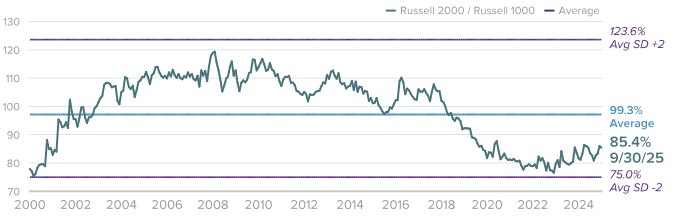
Secondly, valuations for the Russell 2000 remain attractive relative to the Russell 1000, based on our preferred valuation metric of EV/EBIT (enterprise value over earnings before interest and taxes).
Relative Valuations for Small-Caps vs. Large-Caps Remain Near Their Lowest in 25 Years
Russell 2000 vs. Russell 1000 Median LTM EV/EBIT (ex. Negative EBIT Companies), 9/30/00 through 9/30/25
Source: FactSet.
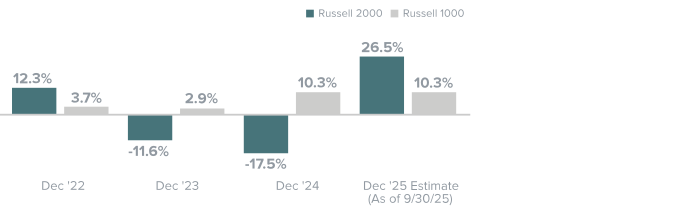
Small-Cap Earnings Expected to Be Stronger Than Large-Caps
With most small-cap companies’ debt being floating rate, even conservatively capitalized small-cap businesses will benefit from lower rates. More importantly, many small-cap companies are emerging from a two-year earnings recession, suggesting that better earnings growth could enhance performance for this asset class, which has lagged behind large-caps for several years. Additionally, recent federal legislation allows businesses to deduct the entire cost of eligible assets in the year they are placed in service, further boosting cash flow.
Small-Cap’s Estimated Earnings Growth is Expected to Be Higher Than Large-Cap’s in 2025
One-Year EPS Growth
Past performance is no guarantee of future results.
Earnings per share (EPS) is calculated as a company’s profit divided by the outstanding shares of its common stock. The EPS Growth Estimates are the pre-calculated mean two-year EPS growth rate estimates by brokerage analysts. Estimates are the average of those provided by analysts working for brokerage firms who provide research coverage on each individual security as reported by FactSet.
The overarching theme for both the market and economy remains “resilience in the face of uncertainty,” which will be tested further during the federal government shutdown. Despite various uncertainties, consumer spending continues, the economy is growing, and access to capital has improved with lower rates. For active small-cap investors, a long-sought leadership seems to have finally emerged, supported by lower rates and a vibrant economy. The case for small-cap leadership is further strengthened by attractive relative valuations and growing earnings strength.
|
Important Disclosure Information The thoughts concerning recent market movements and prospects for small-company stocks are solely those of Royce Investment Partners, and, of course, there can be no assurances with respect to future small-cap market performance. Past performance is no guarantee of future results. Historical market trends are not necessarily indicative of future market movements. The performance data and trends outlined in this presentation are presented for illustrative purposes only. Past performance is no guarantee of future results. Historical market trends are not necessarily indicative of future market movements. This material is not authorized for distribution unless preceded or accompanied by a current prospectus. Please read the prospectus carefully before investing or sending money. Investments in securities of micro-cap, small-cap, and/or mid-cap companies may involve considerably more risk than investments in securities of larger-cap companies. (Please see “Primary Risks for Fund Investors” in the prospectus.) Investments in foreign companies may be subject to different risks than investments in securities of U.S. companies, including adverse political, social, economic, or other developments that are unique to a particular country or region. (Please see “Investing in International Securities” in the prospectus.) |
Editor’s Note: The summary bullets for this article were chosen by Seeking Alpha editors.