

Those are:
Today, we’re diving into gamma, often referred to as the “delta of delta.” Delta measures an option’s sensitivity to price changes in the underlying asset. For instance, a $1.00 move in the underlying results in a $0.30 move in an option with a delta of 0.30. This concept is straightforward.
Gamma operates in a similar fashion. It measures how sensitive the delta is to price changes in the underlying. For example, an option with a delta of 0.30 and a gamma of 0.03 would have a delta of 0.33 after a $1.00 move in the underlying.
The Importance of Gamma
At first glance, gamma might appear to be just another intriguing metric, akin to those hyper-specific statistics sports announcers love to cite. For example, “This quarterback throws interceptions twice as often when targeting defensive backs whose last name starts with a ‘B.'” Interesting, but does it hold any real significance?
However, the gamma of an options position has substantial implications for how profit and loss (P&L) will evolve over the life of that position. Positions with positive gamma exhibit very different characteristics compared to those with negative gamma.
To provide some context, Goldman Sachs stated:
Gamma – the potential delta-hedging of options positions – is one of the more prominent sources of non-fundamental economic activity in global markets. Market makers who delta-hedge their option positions are economically driven to trade substantial amounts of underlying shares or futures strictly as a result of the price of the underlying itself changing, not as a result of fundamental news and without regard to the liquidity available. As a result, gamma can cause markets to overreact to essential news (“short gamma”) or under-react to crucial information (“long gamma”).
Gamma can significantly influence an options position at times, while at other times, it may be a relative non-factor. Understanding gamma and its interplay with other Greeks is crucial for recognizing when your P&L is driven by gamma.
Similar to delta, gamma can be either positive or negative. A favorable gamma position is often termed “long gamma,” while negative gamma is referred to as “short gamma.”
What is a Long Gamma Options Position?
A trader is considered long gamma when their options position has positive gamma, which typically involves being net-long options.
Most non-professional options traders operate within the positive gamma realm. Common examples of long gamma trades include outright long calls or puts and vertical debit spreads.
As a general rule, long gamma positions are often short theta, meaning they experience the negative carry of theta decay.
Consequently, long gamma positions thrive in strong trending markets, while they may see a gradual decline in P&L during sideways, range-bound markets due to theta decay.
In contrast to short gamma positions, your total exposure in a long gamma position increases when you are correct in your trade. For instance, if you are long a call (a favorable gamma position), your deltas will rise as your trade moves in your favor.
This aspect of long gamma positions makes them significantly easier to manage than short gamma positions. It’s psychologically simpler to handle positions when your exposure only grows if you are already making money. Provided you size your positions appropriately, you won’t have to worry about them spiraling out of control. And when you are right, the rewards can be substantial.
To enhance gains, traders might also consider gamma scalping.
What is a Short Gamma Options Position?
If you’ve participated in online options trading discussions on platforms like Twitter and Reddit, you may already be familiar with short gamma positioning, which is often linked to the phenomenon known as the ‘gamma squeeze.’
A short gamma position is characterized by being net-short options, encompassing all the benefits and drawbacks of selling options. This position carries negative gamma exposure.
A position with negative gamma indicates that the delta will decrease when the stock price rises and increase when the stock price falls. Short call and short put positions are examples of negative gamma.
Specifically:
- Benefits from low volatility and sideways price action
- Exposure grows in the wrong direction (your position gets larger when you’re incorrect)
- Typically exhibits concave payoff profiles (limited gains for potentially larger losses)
- Vulnerable to “gamma squeezes.”
- Benefits from theta decay
What is a Gamma Squeeze?
A gamma squeeze is a distinct topic from evaluating the pros and cons of gamma levels in your options positions, but explaining it can highlight the power of gamma.
A gamma squeeze occurs when an excessive number of traders, primarily market makers, find themselves in a short gamma position during a sudden increase in market volatility. This forces market makers to rapidly adjust their delta hedges, further fueling the rally and creating a feedback loop.
Essentially, options traders have deduced two key points about option market makers:
- They are often short gamma
- They systematically delta hedge
The logical follow-up is that if a rapid price movement occurs while market makers are heavily short gamma, their hedging response will create a feedback loop, continuously pushing the price in the direction of the trend.
Here’s how this theoretically unfolds:
-
Market makers are generally short gamma and short options because customers tend to be long options for hedging and speculation.
-
This tendency is amplified in stocks favored by retail traders who often buy out-of-the-money (OTM) calls, which have high gamma, leading market makers to become very short gamma.
-
When a catalyst triggers a surge in call buying, the rapid price movements in the underlying force market makers to adjust their delta hedges, further fueling the rally and creating a feedback loop.
How Expiration Impacts Gamma
Gamma is typically higher for options that are at-the-money and closer to expiration. A front-month option will exhibit more gamma than a LEAPS option with the same strike because the delta of near-term options is more likely to move toward either 0 or 1.00. With increased gamma, investors can witness more dramatic shifts in delta as the underlying moves, especially when the underlying is near the strike at expiration.
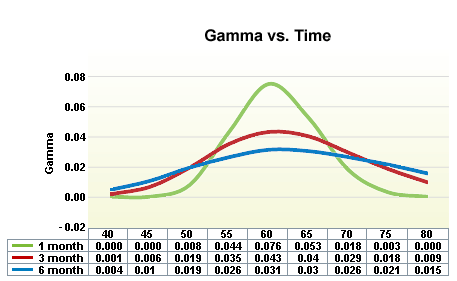
Gamma is lower in longer-dated LEAPS since more strikes remain viable for being in-the-money at expiration due to the extended time frame. An at-the-money option’s delta is typically the most sensitive to moves in the underlying, resulting in higher gamma. When the stock is right at a strike at expiration, the option’s gamma peaks as the delta can rapidly shift from 1.00 toward 0 or vice versa as the underlying crosses a strike. In these scenarios, gamma can be exceptionally high as the delta changes swiftly with the underlying at the strike and expiration approaching.
The example of a gamma squeeze, even if it may be somewhat overhyped today, perfectly illustrates the importance of understanding gamma in options trading. It serves as a real-life example of the power of gamma and the market movements it can catalyze. The Gamma Risk is real; don’t overlook it.
If you enjoyed this article, visit our Options Education Center and Options Trading Blog for more insights.
Related articles