

It might feel like yesterday, but it’s been over half a decade since the COVID-19 pandemic shut down the world, grounding Carnival Corporation‘s (CCL -1.57%) ships and forcing it to take on billions in long-term debt to stay afloat. Now, business is booming.
But is the company rebounding fast enough to overcome its overleveraged balance sheet? Let’s dig deeper into the pros and cons of buying the stock.

Image source: Getty Images.
Carnival’s stock has soared by over 200% from its lows in mid-2020. This rally is largely attributed to the company’s profitable operations. In the third quarter, revenue grew by 3.3% year over year to a record $8.15 billion, while net income jumped 6.7% to a record of $1.85 billion. The cruise company is successfully transporting more guests at higher prices while keeping operational costs in check.
According to CEO Josh Weinstein, Carnival has now notched 10 consecutive quarters of record revenue. Although cruising is considered luxury spending that typically declines in a weak economy, there are reasons for investors to remain optimistic. Consumer deposits remain high, totaling $7.1 billion for the third quarter. Additionally, macroeconomic tailwinds, such as lower interest rates, could further stimulate consumer spending.
Interestingly, Carnival’s robust demand isn’t mirrored across the entire U.S. tourism industry. For instance, The New York Times reports that Las Vegas is currently experiencing a historic slump due to higher prices, consumer uncertainty, and fewer international arrivals. It remains unclear how Carnival has managed to sidestep these challenges and how long its favorable conditions will last.
Is the debt problem under control?
As previously mentioned, Carnival has had to raise substantial amounts of debt and issue additional shares to survive the pandemic, during which its ships were unable to operate due to lockdowns and travel restrictions. This level of equity dilution and cash outflow could undermine investor returns for years, if not decades. Carnival’s shares outstanding skyrocketed in 2020.
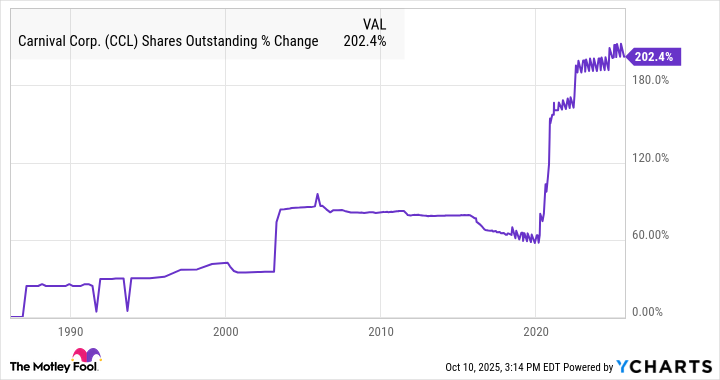
CCL Shares Outstanding data by YCharts
While the equity dilution is concerning, the long-term debt is arguably the most pressing issue, as it incurs interest expenses (amounting to $317 million in the third quarter alone) and must be repaid. Currently, Carnival’s total long-term debt stands at a staggering $25 billion.
The silver lining is that Carnival has made significant strides in reducing its debt. In the third quarter, the company retired approximately $700 million of debt through prepayment and refinanced $4.5 billion. Additionally, falling interest rates will facilitate management’s ability to replace older, higher-interest notes with new, cheaper ones.
Carnival stock is not as cheap as it looks
Carnival Corporation is a stable, growing business that is experiencing healthy demand for its services, even amidst weaknesses in other sectors of the tourism economy. Moreover, it is making commendable progress in managing its debt levels. So, what’s the catch? The short answer is valuation.
At first glance, Carnival stock appears inexpensive, boasting a forward price-to-earnings (P/E) ratio of just 12, corresponding to a market capitalization of $38 billion. However, when factoring in the company’s enterprise value, which provides a more accurate assessment of acquisition costs by including debt levels, the equity’s valuation surges by 68% to $64 billion. This makes it appear quite pricey, especially considering the uncertainty surrounding the sustainability of tourism demand.
While Carnival is far from a poor investment, potential investors should explore safer and more affordable options currently available in the market.