

“Those are some crazy numbers.”
An old friend recently reached out, and that line immediately caught my attention. He was referring to the staggering 36 trillion dollars—the current national debt. It’s a striking figure, prompting the question: how did the country’s debt balloon from a trillion dollars back in 1981 to 36 times that today?
“Very irresponsible, imo,” my friend added.
This sentiment resonates with many, as it seems a reasonable response. However, the challenge lies in how most people view the debt in isolation, neglecting the various factors we’ll explore today.
My perspective is clear: the rising US government debt is not a valid reason to shy away from stocks or, specifically, the 8%+ yielding closed-end funds (CEFs) that include our favorite stocks. I’m referring to funds that hold robust blue-chip companies, such as Visa (NYSE:), JPMorgan Chase (NYSE:), and NVIDIA (NASDAQ:).
Beyond Alarmist Debt Headlines
It’s true that excessive debt is unsustainable, and ultimately, we taxpayers bear the responsibility for it. Yet, there’s more to the narrative.
In 2017, total government debt reached $20 trillion. Interestingly, that was the last time I delved deeply into this topic. My stance remains unchanged: the US government is financially healthier than the average American.
This is largely because people often view the debt in isolation. The US government possesses numerous tools and favorable trends that make managing its debt more feasible than many realize.
Let’s consider a crucial figure: the annual revenue the government collects through taxes and fees.
Currently, about 18% of the US economy contributes to federal revenue, amounting to approximately $5.2 trillion. If Uncle Sam were to allocate all of that revenue to debt repayment (which is, of course, impractical), he could clear it in about six-and-a-half years.
Here’s the key takeaway: that six-and-a-half years is only slightly higher than the six years it would have taken in 2017. It’s worth noting that a pandemic occurred in that timeframe, significantly impacting public debt.
Thus, when viewed through this lens, government debt has remained relatively manageable compared to eight years ago, and it would likely be even more so if not for COVID-19.
Now, let’s further analyze debt in relation to GDP growth:
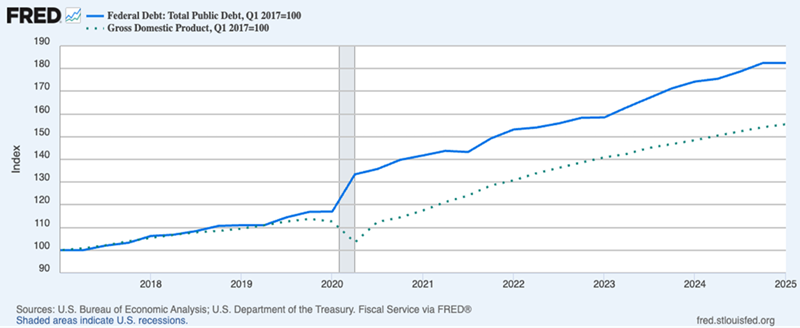
Before the pandemic, both federal debt and GDP were growing at nearly the same rate. The pandemic caused a spike in debt, while GDP also suffered due to lockdowns. Over the last eight years, GDP has increased by about 55%, while total debt has surged by approximately 80%.
This indicates that America’s debt-to-income ratio is worse than it was pre-pandemic, but this isn’t due to a structural issue; the pandemic is the primary culprit.
Still, a one-time hit could pose long-term challenges, right? Certainly, but consider this chart.
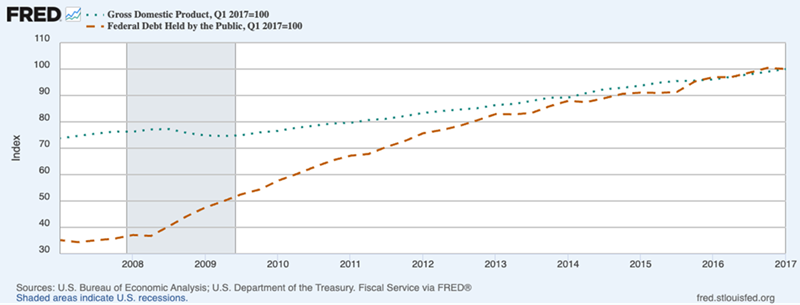
The increase in government debt due to the COVID-19 crisis appears alarming due to the sheer numbers. However, when compared to the significant rise in debt following the 2008/2009 financial crisis, the 2020 increase seems relatively minor.
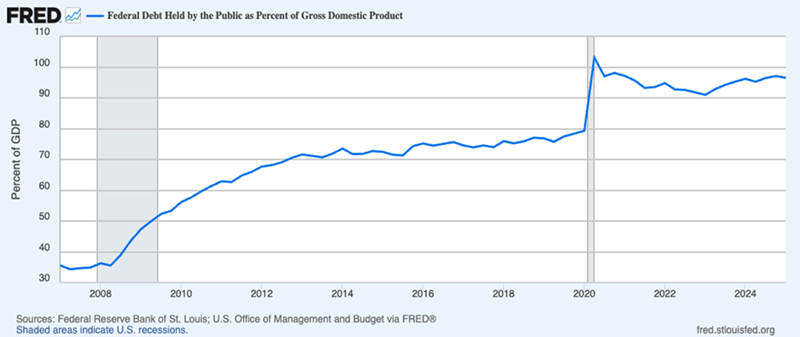
Before 2008, the US public debt-to-GDP ratio was around 35%. In less than five years, it doubled to 70%, where it remained until the pandemic pushed it above 100%, before settling at 96% currently.
On a relative scale, the spike in 2008 was significantly worse than that of 2020. Yet, America weathered that storm just fine. Therefore, there’s no need for concern unless this trend shifts direction.
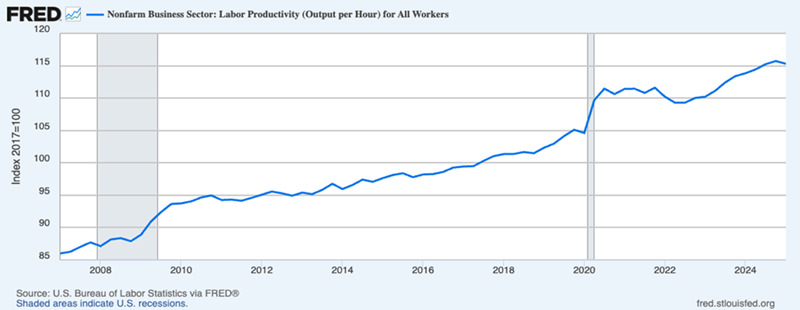
The real story lies in labor productivity. Since 2007, it has risen by a third, meaning Americans now produce about $1.33 for every dollar they produced back then. This upward trend signifies progress, growth, and prosperity. With the advent of AI, productivity is poised for another boost.
This also explains why the market has delivered 10.4% annualized returns over the last two decades, consistent with the 10.3% annualized returns over the past century. During this period, federal debt has increased, as has the government’s income, driven by higher productivity leading to increased GDP.
If you’re contemplating reducing your US holdings due to the debt, keep these three points in mind:
- US assets have appreciated alongside the debt.
- The pandemic caused a more significant debt increase than would have otherwise occurred, but this bump is relatively minor compared to the rise following the Great Recession.
- US stocks have thrived even as debt has escalated.
Now is the time to enhance our US holdings, particularly through CEFs yielding 8%+, which is undoubtedly the best approach.
With CEFs, we gain exposure to strong blue-chip stocks, often at a discount, as these funds’ market prices can—and frequently do—trade below their portfolio values. This is referred to as a “discount to NAV” in CEF terminology.
High dividends and significant discounts from S&P 500 stocks are hard to find elsewhere. It’s nearly impossible to achieve this through index funds or direct stock purchases. Any fears—leading to larger discounts—stemming from exaggerated debt concerns only sweeten our investment opportunities.
Disclosure: Brett Owens and Michael Foster are contrarian income investors who seek undervalued stocks and funds across the U.S. markets. Click here to learn how to profit from their strategies in the latest report, “7 Great Dividend Growth Stocks for a Secure Retirement.”