
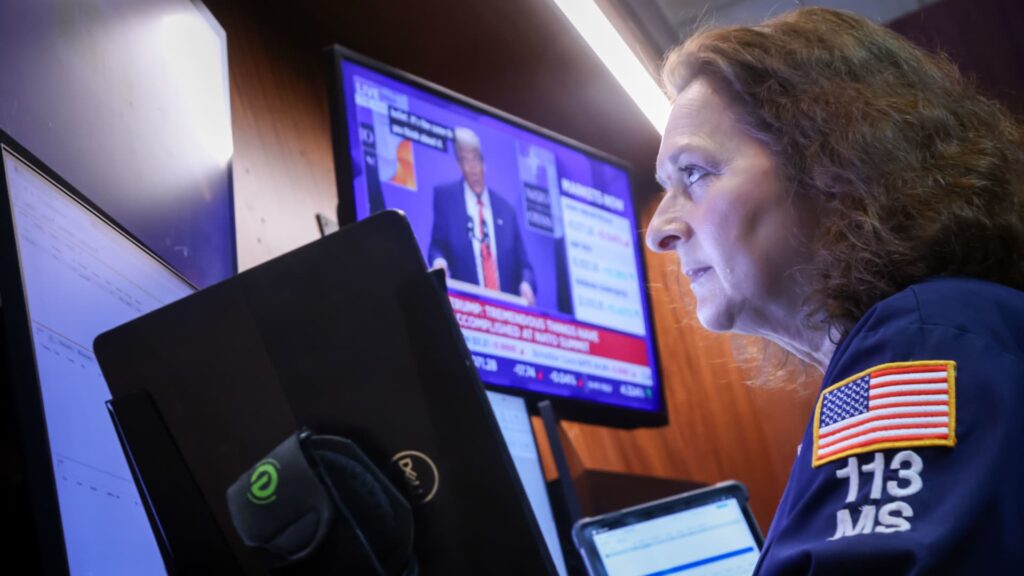
The Dow Jones Industrial Average plummeted by over 870 points in response to Trump’s post, while the S&P 500 experienced a decline of approximately 2.7%, breaking a 33-day streak without a significant move in either direction. U.S.-listed shares of Chinese companies and related ETFs took a hit, with the iShares MSCI China ETF (MCHI) dropping more than 5%. In contrast, U.S.-based rare earth miners saw a rally, as investors anticipated increased demand for resources sourced outside of China.
“Clearly, our relationship with the second-largest economy in the world just got more difficult,” remarked Art Hogan, chief market strategist at B. Riley Wealth. The technology sector was particularly hard-hit, with the Nasdaq Composite falling over 3.5%, marking its worst day since April. Hogan noted that this downturn is understandable given the sector’s significant exposure to China in both manufacturing and consumption.
As the market reacted, the CBOE Volatility Index (VIX), often referred to as Wall Street’s “fear gauge,” surged to levels not seen since June, highlighting growing concerns among traders. However, not all investors are fleeing the market. Some view the recent drop as a natural correction, given the strong performance of stocks leading up to this point. Larry Tentarelli, founder of the Blue Chip Daily Trend Report, pointed out that 2%-3% declines from recent highs are common and suggested that this could be an opportune moment to increase exposure to a market that is nearing record levels, especially in high-flying sectors like artificial intelligence and technology.
“I think this will be an opportunity to buy the pullback,” Tentarelli stated. He believes that the U.S. and China may be engaging in some degree of posturing, which could lead to short-term market fluctuations.
Vital Knowledge founder Adam Crisafulli echoed this sentiment, suggesting that investors perceive the situation as posturing, with both nations having reasons to avoid further escalation. However, he cautioned that the risks of a renewed conflict are increasing. Historically, investors have embraced the notion of a “TACO” trade, implying that Trump often “chickens out” on policy, viewing it as a strategy to gain leverage rather than a definitive stance.
Tim Seymour of Seymour Asset Management highlighted that China possesses its own leverage concerning rare earth materials. Jay Woods, chief market strategist at Freedom Capital Markets, raised the question of what comes next. He speculated that this could be another negotiating tactic from the White House, suggesting that the current market downturn might ultimately present a “buying opportunity.”
Woods is among several market participants weighing Trump’s threats against the backdrop of the ongoing federal government shutdown and the impending earnings season, which kicks off next week. “As we head into earnings season next week, this latest threat just throws a cloud of uncertainty the market didn’t need on top of the current shutdown,” he noted.
Infrastructure Capital CEO Jay Hatfield characterized the market’s reaction on Friday as “normal.” While he acknowledged that uncertainty is not ideal for investors, he believes the market will stabilize once earnings reports begin to roll in. Hatfield emphasized the distinction between a tariff and a trade war, noting that the latter disrupts all commerce between two nations. He remarked that this development pushes the U.S.-China relationship back into “trade war” territory. “The market was really priced for perfection,” he concluded. “A trade war is not perfection.”