

Equity Strength in Q3 Shows Signs of Broadening

Despite inflation concerns and signs of weakness in the labor market, equities experienced a rally in Q3. Market participation broadened, driven by improving trade policies, optimism surrounding rate cuts, and better-than-expected corporate earnings. The Nasdaq Composite Index and S&P 500 Index recorded their best Q3 performances since 2020, along with their strongest September in 15 years, despite the month’s typical poor seasonality. For the quarter, US growth (+9.8%) led the pack, followed closely by emerging markets (+9.5%) and US small-caps (+9.2%). Bonds also performed well, with municipal bonds rising 2.7%, investment-grade corporates gaining 2.7%, and high-yield credits increasing by 2.4%. Commodities saw positive returns as well, with silver up 29.1%, gold rising 16.6%, broad-based commodities increasing by 3.7%, and crude oil gaining 0.9%.
Fed Rate Cuts Return as Labor Market Softens
The Federal Reserve cut the fed funds rate by 25 basis points during the September FOMC meeting, lowering the target range to 4.00–4.25%. This marked the resumption of an easing cycle that began last year. Chair Powell acknowledged the softening labor market, stating that “revised jobs numbers mean the labor market is no longer solid” and that low hiring has become “a growing concern over the last few months.” Governor Stephen Miran, a newly appointed Fed governor and former Treasury official, was the sole dissenter advocating for a deeper 50 basis point cut, reflecting market calls for more aggressive action. The updated Summary of Economic Projections (SEP) indicated that inflation, as measured by the Core Personal Consumption Expenditures (PCE) price index, is expected to remain above target at 3.1% for 2025, while GDP growth for the year was revised upward to 1.6% from the previous projection of 1.4%. Revised figures also suggested roughly 50 basis points of additional cuts through year-end, with further reductions anticipated into 2026–27. However, officials emphasized that the pace of easing will depend on incoming data, as the simultaneous expected rise in both inflation and unemployment complicates future decisions. In his recent speech at the 2025 Economic Outlook Luncheon, Powell noted that equity prices are “fairly highly valued,” cautioning that the path of rate cuts may be shallower than what markets currently anticipate.

Performance Around First Rate Cut After a Pause
Historically, the S&P 500 has tended to rally significantly over the subsequent 12 months following at least a 6-month pause in past Fed cutting cycles. Current market performance (orange) was weaker than the historical average in the months leading up to the September cut. The question remains: will equities follow their historical pattern in the post-cut period?

Potential Shift Ahead for Market-Cap Weight vs. Equal Weight
The S&P 500 Equal Weight index typically lags when mega-caps lead but has historically outperformed its market-cap weighted counterpart when leadership broadens. The market-cap weighted version has dominated the equal weight index for much of the past five years and is currently experiencing its best streak since the late 1990s. However, historical trends suggest this dominance may soon end, a shift that could be further supported by the recent dovish turn in monetary policy. Notably, during the Dot Com Bubble, the equal weight index performed significantly better than the cap-weighted S&P, as it was less concentrated in overvalued mega-cap technology companies.

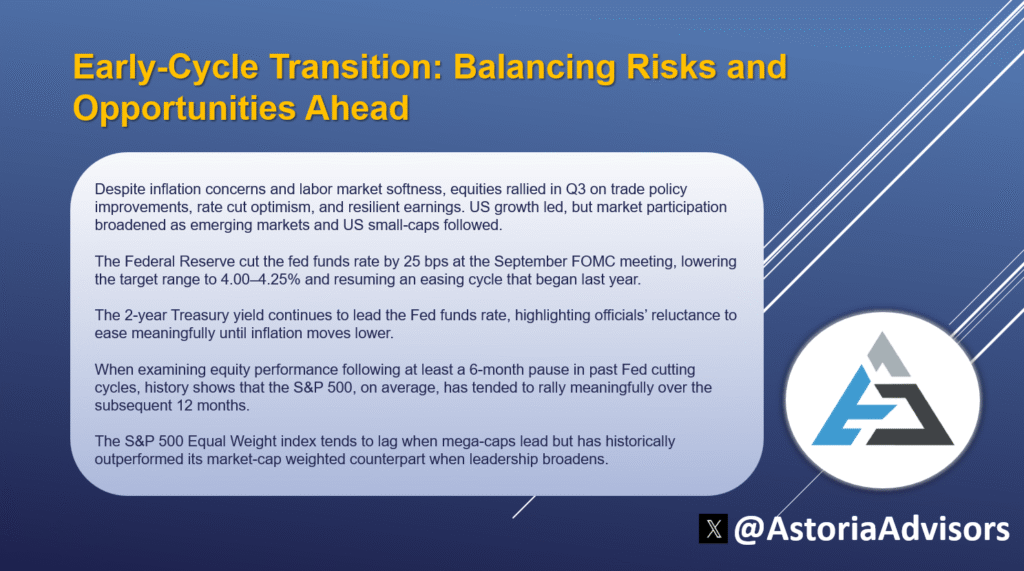
Early-Cycle Transition: Balancing Risks and Opportunities Ahead
While the economy exhibits signs of a late-cycle environment, early-cycle signals are emerging alongside a more dovish monetary policy outlook. Fundamentals appear constructive in sectors such as banks and small to mid-cap equities, with expectations that the earnings growth gap between the largest technology firms and the broader market will narrow soon. However, challenges remain, including a softening labor market, persistent inflation risks, and policy uncertainty stemming from tariffs, creating a complex backdrop. Importantly, the data does not indicate a recession: earnings revisions have improved significantly, corporate results have exceeded expectations, and both manufacturing and services PMIs remain near or above expansionary thresholds. These dynamics underscore the importance of maintaining a broader perspective, as markets continue to look forward amidst near-term fluctuations.
For more news, information, and strategy, visit the ETF Strategist Content Hub.
Warranties & Disclaimers
There are no warranties implied. Past performance is not indicative of future results. Information presented herein is for educational purposes only and does not intend to make an offer or solicitation for the sale or purchase of any specific securities, investments, or investment strategies. Investments involve risk and, unless otherwise stated, are not guaranteed. The returns in this report are based on data from frequently used indices and ETFs. This information contained herein has been prepared by Astoria Portfolio Advisors LLC on the basis of publicly available information, internally developed data, and other third-party sources believed to be reliable. Astoria Portfolio Advisors LLC has not sought to independently verify information obtained from public and third-party sources and makes no representations or warranties as to the accuracy, completeness, or reliability of such information. Astoria Portfolio Advisors LLC is a registered investment adviser located in New York. Astoria Portfolio Advisors LLC may only transact business in those states in which it is registered or qualifies for an exemption or exclusion from registration requirements.