
Not every dividend stock needs to boast a sky-high yield or be the latest tech sensation. Often, the best performers are the quiet giants—companies that consistently deliver results year after year. When you discover a business that influences nearly every sector of the economy while still achieving growth, it deserves your attention. One of the most powerful financial entities in the U.S. might be right under your nose.
A Network that Prints Cash
Beneath its physical branches and digital interfaces lies one of the most formidable banking operations in the U.S. Few institutions have such extensive influence across consumer, commercial, and capital markets. Whether you’re swiping a card, applying for a mortgage, or trading stocks, Bank of America is likely involved in the background.
Bank of America (BAC) thrives on a scalable business model that operates through four primary segments: Consumer Banking, Global Wealth & Investment Management (GWIM), Global Banking, and Global Markets. From everyday depositors to billion-dollar corporations, it serves a diverse clientele. Its dominance in deposits, card usage, and wealth management fosters deep, lasting client relationships. The integration of Merrill Lynch enhances its wealth management capabilities, while digital tools like Erica and Zelle strengthen customer loyalty in the retail sector.
When a Scale Becomes a Superpower
Bull Case: Efficiency and Reach in a Higher-Rate World
Bank of America’s multi-segment model is well-positioned to thrive in a rising interest rate environment, which is exactly what we are experiencing. With over $1.9 trillion in deposits and a disciplined loan portfolio, BAC’s net interest income is robust. In 2025, it is projected to grow by 6.8% year-over-year. The bank’s digital transformation has also yielded positive results: nearly 75% of households now utilize digital platforms, which reduces overhead and enhances profit margins.
Merrill Lynch contributes a steady stream of fee-based revenue, while Bank of America’s involvement in fixed-income and equities trading provides an additional advantage in volatile markets. Wealth and Investment Management, which includes Merrill and the Private Bank, saw an 8% year-over-year increase in Q1, driven by a 15% rise in asset management fees. This combination of stability and cyclical growth potential is hard to match.
Retail growth remains strong. BAC continues to invest in new financial centers while optimizing its branch network, ensuring both reach and cost efficiency. With one of the largest technology budgets in the industry, it is well-equipped to fend off fintech competition.
Bear Case: Regulatory Shadows and Competitive Tensions
Despite its strengths, BAC has vulnerabilities. Over 50% of its revenue still comes from net interest income, making it susceptible to falling rates or economic downturns that could quickly compress earnings. As a systemically important financial institution (SIFI), the bank is also under constant regulatory scrutiny. Compliance requirements and stress test obligations can limit operational flexibility.
While the loan portfolio is solid now, a recession could quickly change that landscape. Consumer delinquencies are rising in certain segments, and charge-offs may increase if employment rates decline. The threat from fintech is real; although BAC has the resources to compete, agile disruptors often set the pace for customer expectations.
Finally, competition is fierce. JPMorgan Chase remains a powerhouse in both investment and consumer banking, while Wells Fargo is gradually recovering. BAC must continually defend its market position.
Get Our Tool to Build a Reliable Retirement
Looking to create a portfolio that generates sustainable income in any market? Download the Dividend Income for Life Guide—your free, practical roadmap to retirement peace of mind.
Inside, you’ll find:
-
A breakdown of the Dividend Triangle framework
-
Portfolio-building rules for consistent income
-
Examples of resilient stocks across sectors
-
Red flags to avoid when chasing yield
Download the Guide now and give your portfolio the income backbone it deserves.
What’s New at BAC
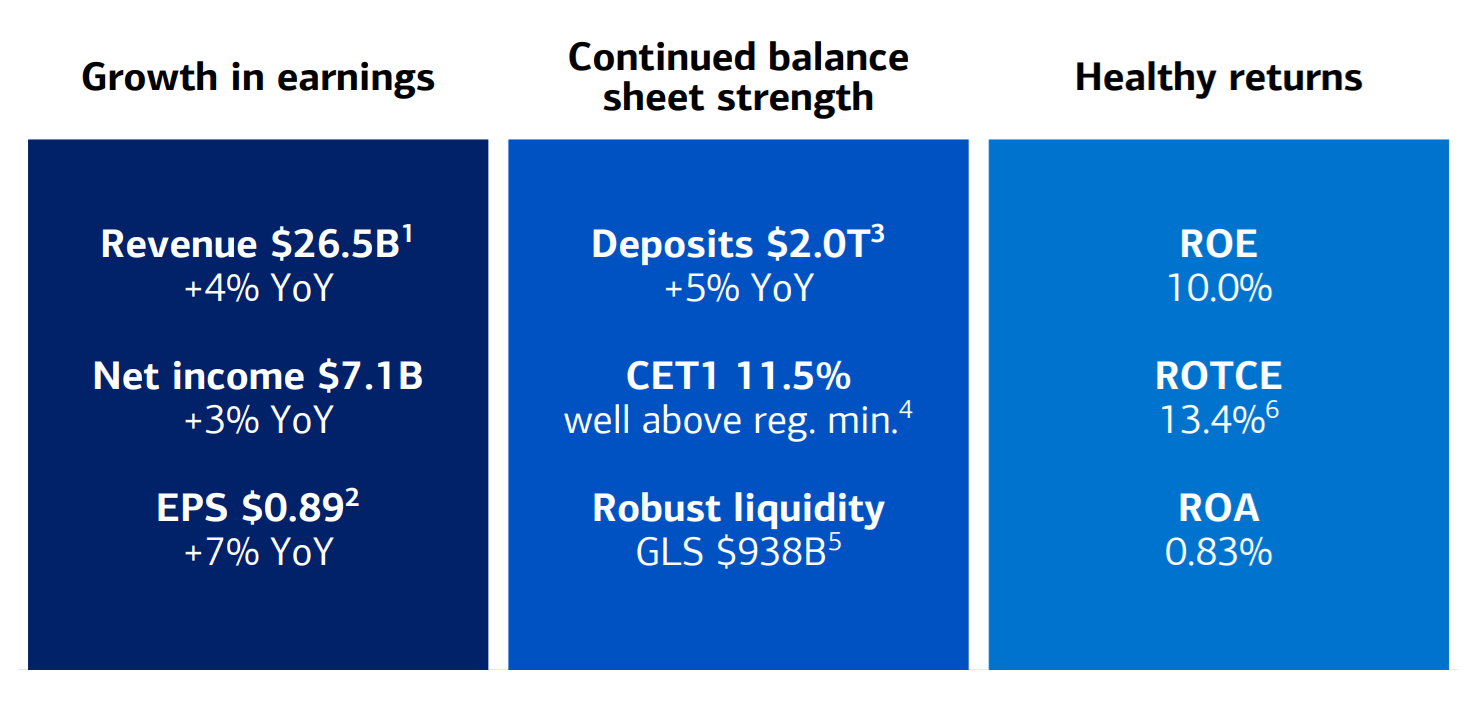
The bank started the year strong, showing solid performance across nearly all divisions. Here are the key takeaways from its latest quarterly report:
-
Revenue rose 4% YoY, surpassing $26.5B.
-
EPS surged 18%, exceeding analyst expectations.
-
Net interest income climbed 3%, benefiting from a favorable rate environment.
-
Non-interest income increased 10%, driven by asset management and trading.
-
Consumer Banking gained 3% YoY, supported by strong card income and service charges.
-
Global Wealth & Investment Management grew 8%, buoyed by a 15% rise in fees.
-
Global Markets jumped 12%, with record equities trading revenue of $2.2B.
This broad-based growth illustrates how BAC’s multi-faceted approach can sustain momentum, even if one segment slows.
The Dividend Triangle in Action: BAC’s Performance Map
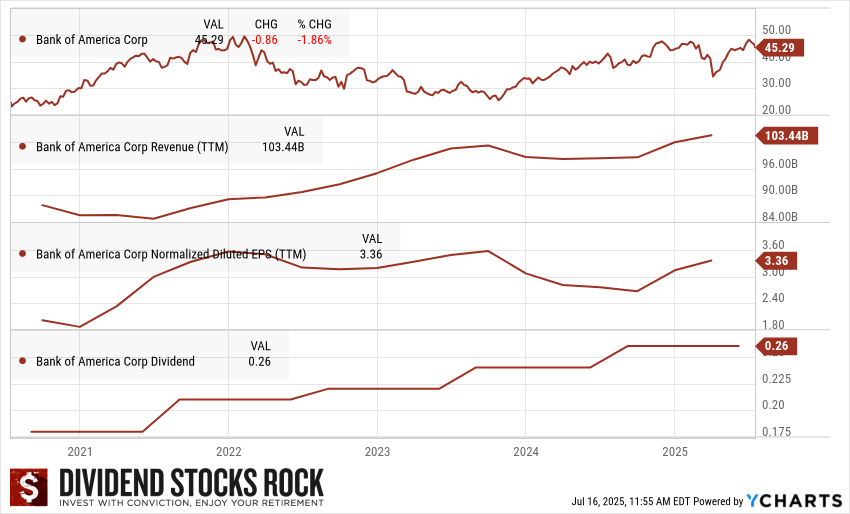
Bank of America meets all three criteria of the Dividend Triangle—Revenue Growth, Earnings Growth, and Dividend Growth—though with some caveats:
-
Revenue: TTM revenue stands at $103.44B, indicating solid multi-year growth.
-
Earnings: EPS has rebounded from a dip in 2023, now reaching $3.36 TTM.
-
Dividend: BAC pays a $0.26 quarterly dividend and has gradually increased it over time, though not at a rapid pace.
While the dividend may not be flashy, it is supported by strong cash flow. BAC’s payout ratio remains conservative, allowing room for future increases—especially if interest rates remain stable.
Final Thoughts: Not Sexy, but Strategic
This isn’t the stock that will triple overnight. However, in a market filled with hype, there is significant value in a stable, diversified income generator like BAC. With reliable earnings, a clear dividend strategy, and exposure to multiple growth avenues, it’s the kind of stock that can quietly anchor a portfolio.
Build a Dividend Portfolio that Lasts
The Dividend Income for Life Guide is filled with resources to help you take charge of your retirement income:
-
Screens based on our Dividend Triangle methodology
-
Proven frameworks for quick stock evaluation
-
Tips for sector diversification to ensure long-term durability
It’s free. It’s your edge.
Download it here and start building a future-proof portfolio today.